

Leading China Access Control Manufacturer: Android Biometric & Fingerprint Attendance Systems with 4G/Wi-Fi
China Best Fingerprint Attendance Systems factory
Summary
Commercial security and workforce management require dependable hardware capable of operating in complex enterprise environments. This analysis evaluates multi-modal identification terminals designed for modern access management, highlighting data protection standards, multi-network communication redundancy, and enterprise software synchronization. For global integrators seeking a China high-quality Fingerprint Attendance Systems Supplier, selecting hardware that integrates encrypted biometrics with versatile connectivity ensures scalable operational reliability across diverse commercial facilities.
Technical Features Overview
Enterprise access management systems require hybrid verification methods to adapt to varying operational environments and workforce requirements. Modern Android-based biometric terminals unify facial recognition, fingerprint verification, RFID card reading, QR code scanning, and PIN access into a single hardware architecture.
Multi-Modal Biometric Verification
Visible Light Facial Recognition: Utilizes dynamic algorithms to achieve rapid recognition within fractions of a second, accommodating movement, varying illumination levels, and wide-angle capture.
Fingerprint Scanning: Integrated optical or capacitive fingerprint sensors provide secondary biometric verification for environments where face matching may be restricted or optional.
Dual-Frequency RFID Module: Built-in dual-frequency card support (125kHz and 13.56MHz) enables seamless integration with legacy proximity cards and smart ID credentials.
QR Code and PIN Entry: Supports contact-free temporary visitor passes via QR scanning alongside traditional PIN entry for multi-factor security policies.
Connectivity and Data Security
Multi-Network Redundancy: Features comprehensive connectivity options including 4G LTE cellular data, Wi-Fi, Ethernet TCP/IP (RJ45), and Bluetooth 4.1, ensuring uninterrupted cloud synchronization in remote or infrastructure-limited sites.
AES-256 Encryption: All biometric templates, personal logs, and system data transmissions are protected using AES-256 encryption standards to uphold strict international data privacy compliance.
Software Ecosystem Compatibility: Native support for web-based time and attendance software (such as UTime Master) and enterprise access control management platforms (such as UAccess Master) for centralized, real-time administration.
Resolving Core Pain Points in Enterprise Biometric Deployments
B2B procurement teams, system integrators, and facility managers routinely face operational hurdles when deploying workforce management hardware. Selecting a proven Top China Android Biometric Machines Manufacturer helps bridge technical performance gaps with robust, field-tested engineering solutions.
Unreliable Network Infrastructure in Remote Locations
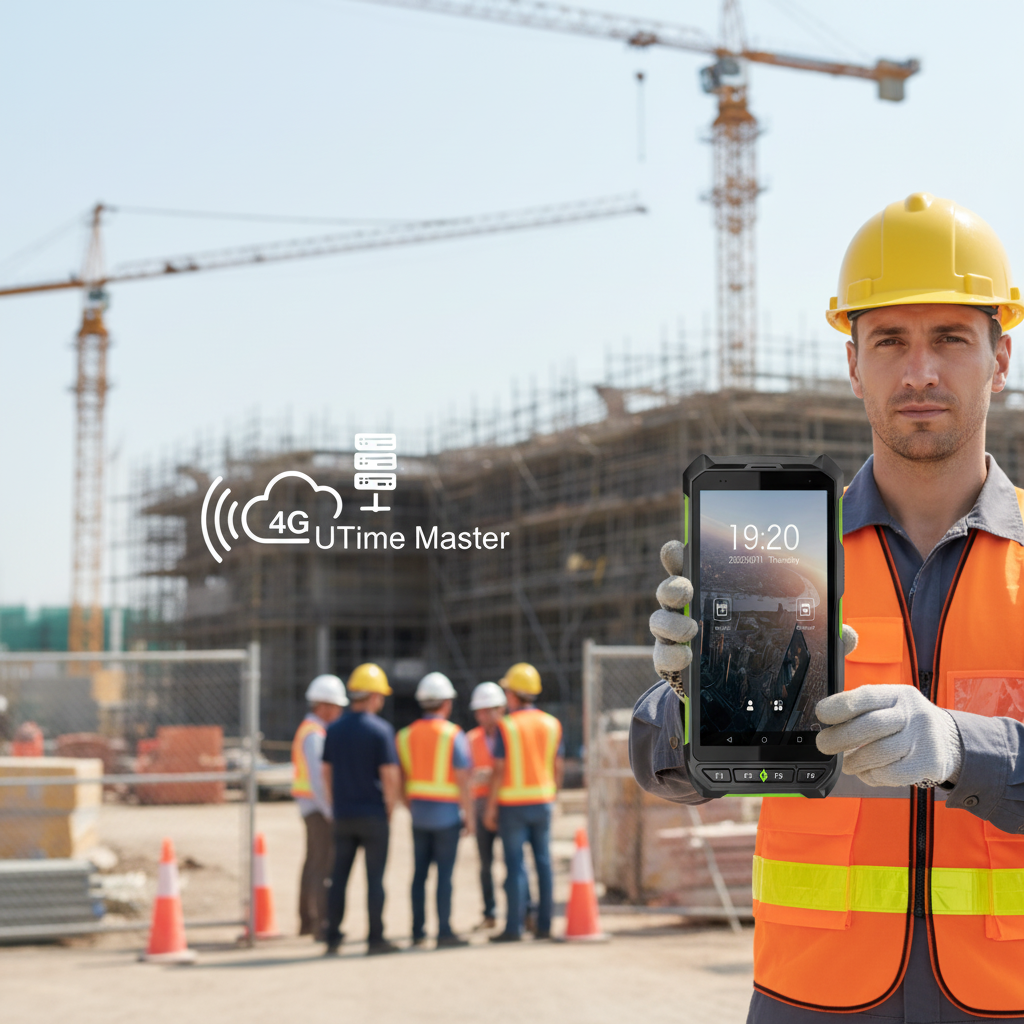
In active construction sites, remote manufacturing facilities, or temporary logistics hubs, wired Ethernet infrastructure is frequently unavailable or cost-prohibitive to install. Traditional attendance systems reliant on local networks stall when connectivity drops, creating data silos and delays in payroll calculation.
With integrated 4G LTE cellular modems alongside Wi-Fi and TCP/IP, Android biometric terminals transmit attendance logs directly to centralized cloud platforms in real time. If cellular network coverage fluctuates, onboard memory stores verification logs locally, automatically synchronizing data once connectivity is restored.
Environmental Illumination and Presentation Attacks
Legacy infrared facial recognition devices struggle under harsh outdoor sunlight or low-light shift changes. Furthermore, traditional systems are susceptible to presentation attacks using printed photos or digital displays.
Visible light facial recognition algorithms automatically adjust to dynamic ambient lighting, recognizing authorized personnel across indoor and outdoor transitions.
Coupled with anti-spoofing technology, the system distinguishes real human faces from high-resolution photo prints or video playback attempts.
Complex Multi-Facility Administration and Mixed Verification Methods
Large organizations managing offices, warehouses, and factories often struggle to manage disparate identity databases. A corporate employee moving between corporate headquarters and a distribution hub shouldn't require separate credential enrollment across systems.
Centralized web-based platforms, such as UTime Master and UAccess Master, manage multi-modal profiles from a single portal. A user can verify via facial recognition at the headquarters turnstile, use a dual-frequency RFID badge at a regional office, or scan a fingerprint at a warehouse door—all updating a unified record in real time.
Application Scenarios for Android Biometric Terminals
Industrial Manufacturing Facilities
In heavy industrial plants, workers' hands may become smudged or worn, reducing the effectiveness of standalone fingerprint readers. Visible light facial recognition provides touchless access at turnstiles, preventing bottlenecks during high-volume shift changes while preserving hygiene standards.
Logistics Hubs and Commercial Warehouses
Distribution centers operate across expansive indoor and outdoor zones with constant contractor movement. Dual-frequency card modules allow third-party drivers to scan RFID badges or temporary QR codes at perimeter gates, while permanent staff use touchless biometric verification.
Corporate Headquarters and Multi-Tenant Towers
High-density corporate environments require flexible credential management. Android biometric terminals provide sleek wall or turnstile mounting options, enforcing multi-factor security rules (e.g., face match plus card scan) for restricted server rooms while serving standard attendance tracking across general floors.
Manufacturing Strengths and Customization Capabilities
Partnering with an established China Best Fingerprint Attendance Systems factory provides international buyers with direct access to tailored OEM/ODM hardware and software integration support.
Research and Development Excellence
With dedicated hardware and software engineering teams, product lines are developed around open Android architectures. This flexibility allows global distribution partners to integrate custom middleware, modify user interface themes, or deploy localized language packs.
Comprehensive Quality Assurance
Every manufacturing cycle undergoes rigorous environmental stress testing, including thermal chamber verification, drop resistance testing, and continuous optical sensor calibration. Manufacturing practices comply with international CE, FCC, and RoHS benchmarks.
End-to-End Enterprise Software Ecosystem
Beyond hardware production, software platforms like UTime Master and UAccess Master deliver scalable cloud infrastructure. Integrators benefit from complete API documentation and webhooks, simplifying synchronization with third-party ERP, payroll, and building management software.
Localized Frequently Asked Questions (FAQs)
How do Android biometric terminals maintain communication across sites without fixed broadband connection?
Devices equipped with built-in 4G LTE and Wi-Fi modules establish secure cellular data tunnels directly to cloud server environments (such as UTime Master). If cellular signals fluctuate, onboard storage preserves verification timestamps locally and automatically syncs them once connection is re-established.
How does the system handle data privacy regulations such as GDPR or local biometric compliance standards?
Biometric templates are stored using advanced cryptographic hashes rather than raw biometric images. All device-to-server data transfers utilize AES-256 encryption. Administrators retain full authority to configure data retention policies and purge records according to local jurisdictional laws.
Can these biometric access control terminals integrate with existing third-party access software?
Yes. Supported by a China high-quality Fingerprint Attendance Systems Supplier, systems provide comprehensive Web APIs and software development kits (SDKs). System integrators can pull attendance logs, manage user databases, and issue access commands directly within third-party HR, ERP, or security management platforms.
Conclusion
For enterprise organizations and security integrators seeking scalable workforce administration, Android-based biometric terminals combine multi-modal verification with resilient multi-network connectivity. Partnering with a dedicated manufacturer ensures long-term system stability, customized software integration, and consistent hardware performance.
Explore full product specifications, software solutions, and global supply opportunities at Granding Technology.
https://www.grandingteco.com/
https://www.grandingteco.com/
+86 13601920731
kayla@granding.com
Legal Disclaimer:
EIN Presswire provides this news content "as is" without warranty of any kind. We do not accept any responsibility or liability for the accuracy, content, images, videos, licenses, completeness, legality, or reliability of the information contained in this article. If you have any complaints or copyright issues related to this article, kindly contact the author above.
